
KCSiE 2026: What’s New? Full Summary of the Changes
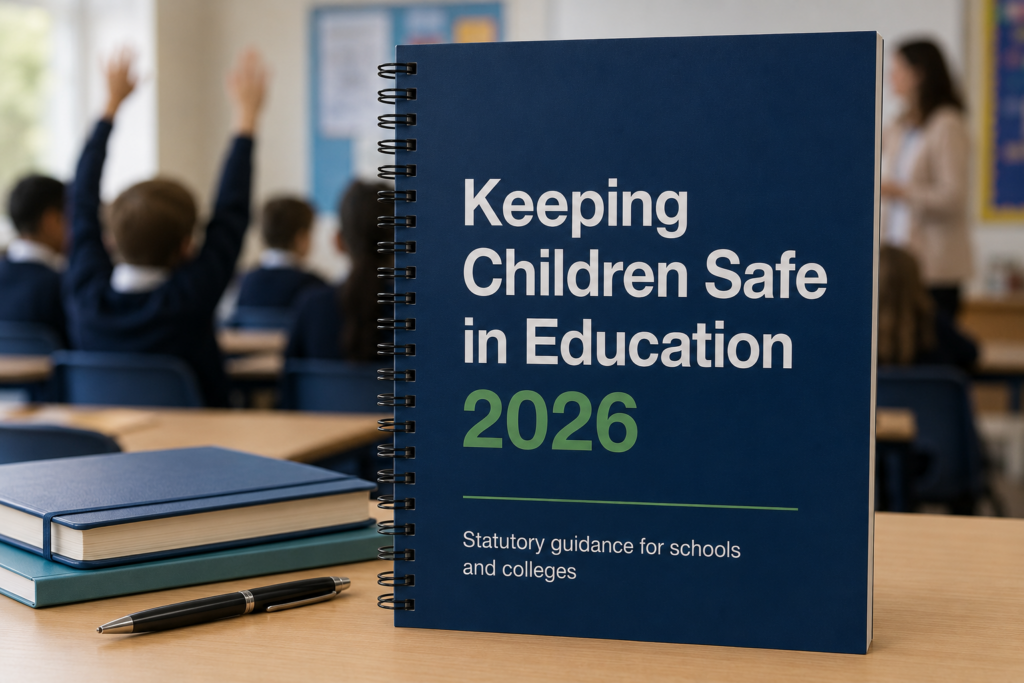
The Department for Education has published Keeping Children Safe in Education (KCSiE) 2026. The new statutory guidance is out “for information”, and it comes into force on 1 September 2026, replacing KCSiE 2025.
If you are a designated safeguarding lead (DSL), headteacher, governor or trustee, this is the moment to get ahead. Below is a clear, plain-English summary of what has changed in KCSiE 2026, why it matters, and what your school or college needs to do to be ready for the new academic year.
Our KCSiE course will be updated for 2026. You and your team will be able to train on the new guidance, well before it takes effect in September.
What is KCSiE 2026?
Keeping Children Safe in Education is the statutory safeguarding guidance that all schools and colleges in England must follow. It is issued by the Department for Education under Section 175 of the Education Act 2002 and is reviewed and updated every year. KCSiE 2026 is the latest version and replaces KCSiE 2025.
The guidance sets out what schools and colleges must do to safeguard and promote the welfare of children (everyone under the age of 18), including who must read what, how to respond to concerns, and the checks required to recruit staff safely.
When does KCSiE 2026 come into force?
The DfE has published KCSiE 2026 in advance, “for information only”. It comes into force on 1 September 2026, the start of the 2026/27 academic year. Until then, KCSiE 2025 remains in force. Publishing early gives schools and colleges time to update their policies, brief their teams and complete the training they need before term begins.
KCSiE 2026 changes at a glance
Here are the most significant KCSiE 2026 changes for schools and colleges:
- Annex A has been withdrawn and all staff are now expected to read Part One in full.
- New guidance on AI, including AI-generated and “deepfake” images, and the safe use of generative AI in education.
- A substantially updated mental health section.
- Filtering and monitoring effectiveness must be reviewed at least once every academic year and recorded, and there is a new mobile phone policy section.
- New and expanded content on Violence Against Women and Girls (VAWG), misogyny and serious violence.
- Updated guidance on children who are LGB or gender-questioning.
- New “Family Help” terminology reflecting wider multi-agency changes.
- A major safer recruitment change: the “supervision exemption” has been removed from regulated activity under the Crime and Policing Act 2026.
The rest of this article explains each of these in more detail.
The biggest change: Annex A has been withdrawn
The headline change in KCSiE 2026 is the removal of Annex A. In previous versions, Annex A was a condensed summary of Part One that staff who did not work directly with children could read instead of the full Part One.
That shortcut has gone. KCSiE 2026 states that governing bodies and proprietors “should now also ensure that those staff who do not work directly with children read Part one of this guidance.” In other words, every member of staff, teaching and non-teaching, is now expected to read Part One in full.
Why the Annex A change matters
This matters for two reasons. First, it means office staff, catering teams, site staff and volunteers all need the same core safeguarding knowledge as classroom staff. Second, it makes whole-team safeguarding training more important than ever. If your induction and refresher training previously relied on the Annex A summary for support staff, that approach will no longer meet the guidance.
Come September, our safeguarding training courses will be designed for your whole team, so every member of staff can meet the new Part One expectation.
Note on the annexes: because Annex A has been withdrawn, the remaining annexes have been renumbered. The former Annex B (Further information) is now Annex A, the former Annex C (Role of the DSL) is now Annex B, and the former Annex E (Regulated activity) is now Annex C.
KCSiE 2026 key changes in detail

AI, deepfakes and online safety
KCSiE 2026 modernises its online safety content to reflect the rapid growth of artificial intelligence. A new explainer on indecent and semi-indecent images runs throughout the guidance and makes clear that images may be “digitally altered or wholly generated using artificial intelligence, including what are sometimes described as ‘deepfakes’.
Two new paragraphs cover the safe and effective use of generative AI in education, and KCSiE 2026 updates the online risk categories. All incidents involving the sharing of indecent or semi-indecent images now require a safeguarding response, whether they are consensual or non-consensual.
If online safety is a priority for your setting, our online safety training for schools will cover these risks in depth come September.
Mental health
KCSiE 2026 substantially updates its mental health content. There is a clearer expectation that all staff understand how mental health concerns can be a safeguarding issue, and it expands the section on children requiring mental health support. Recognising concerns early, and knowing when to escalate, remains central to a whole-school safeguarding approach.
Filtering, monitoring and mobile phones
KCSiE 2026 strengthens the requirements around filtering and monitoring. Schools must review how well their systems work at least once every academic year. The senior leadership team member responsible leads the review, with support from the DSL and IT. Reviews should check that filtering works on all internet-connected devices in all relevant locations, and schools should keep a record.
There is also a new mobile phone policy section, reinforcing the expectation that schools operate as mobile phone-free environments and set out their approach clearly.
Violence Against Women and Girls, misogyny and serious violence
Reflecting national priorities and the recent Casey Audit, KCSiE 2026 expands its content on Violence Against Women and Girls (VAWG). It adds further references to misogyny (and misandry) and substantially updates the section on serious violence. KCSiE 2026 also rewrites Part Five, which covers child-on-child sexual harassment and sexual violence, to highlight the continuum from harmful sexual behaviour through to sexual violence.
Children who are LGB or gender-questioning
KCSiE 2026 updates the content relating to children who are LGB or gender-questioning, giving schools and colleges clearer guidance on how to support these pupils within a safeguarding framework.
Family Help and multi-agency working
KCSiE 2026 updates its terminology to reflect wider reforms to children’s social care. You will now see references to “universal services and community-based early help” and “the targeted early help level of Family Help”, along with new content on referrals to Family Help. These changes anticipate legislation in the Children’s Wellbeing and Schools Bill.
Safer recruitment: the “supervision exemption” has been removed
One of the most important practical changes sits in Part Three. The Crime and Policing Act 2026 has removed the “supervision exemption” from regulated activity. This means anyone who volunteers in a role that involves teaching, training, instructing or supervising children is now in regulated activity. That applies if they do so on more than three days in a month, or overnight, even when a colleague supervises them.
The practical effect is significant for volunteers and DBS checks. As a result, KCSiE 2026 updates or removes the regulated activity tables and the old DBS flowchart. If your setting uses volunteers, now is the time to review your checks. Once September rolls around, our safer recruitment training will reflect the new position.
Other updates worth knowing
KCSiE 2026 also includes:
- Updated data protection references to reflect the Data (Use and Access) Act 2025.
- New sections on sport, young carers, safeguarding children with medical conditions, and boarding and residential accommodation.
- “Child-on-child abuse” retitled to “Child-on-child abuse (including harassment and violence)”, with expanded content noting it is a safeguarding issue for both victim and alleged perpetrator.
- References to trainee teachers added throughout.
- Updated content on reasonable force to reflect new restrictive intervention guidance.
What schools and colleges need to do before September 2026

To be ready for KCSiE 2026 coming into force, most settings will need to:
- Update safeguarding policies to reflect the new guidance, including your child protection policy, mobile phone policy and online safety approach.
- Train all staff on Part One in full, including non-teaching staff who previously relied on Annex A.
- Review filtering and monitoring effectiveness and record the review.
- Review your use of volunteers and DBS checks in light of the removal of the supervision exemption.
- Brief governors and trustees so leadership oversight reflects the changes.
- Refresh DSL knowledge so your designated safeguarding lead and deputies are confident with the updates.
Our live online DSL training is a straightforward way to bring your safeguarding lead up to speed.
How we can help you get ready for KCSiE 2026
We will be updating our courses to reflect KCSiE 2026 from September 2026, so you can train with confidence.
- Safeguarding and child protection training for your whole team.
- Designated Safeguarding Lead (DSL) training for leads and deputies.
- Online safety training and safer recruitment training.
- Sector-specific training for primary schools, secondary schools and childcare and early years.
If you would like an independent check that your safeguarding is ready for the new guidance, our safeguarding consultancy and safeguarding supervision services can help. You can also browse all of our courses or get in touch to talk through what your setting needs.
You can read the full guidance on the GOV.UK Keeping Children Safe in Education page.
KCSiE 2026 FAQs
KCSiE 2026 comes into force on 1 September 2026, the start of the 2026/27 academic year. It has been published in advance for information and replaces KCSiE 2025.
The main changes include the withdrawal of Annex A (all staff must now read Part One in full), new guidance on AI and deepfakes, a substantially updated mental health section, stronger filtering and monitoring requirements, a new mobile phone policy section, expanded content on Violence Against Women and Girls and serious violence, updated Family Help terminology, and the removal of the supervision exemption from regulated activity for safer recruitment.
Yes. The condensed Annex A has been withdrawn. All staff, including those who do not work directly with children, are now expected to read Part One in full, and the remaining annexes have been renumbered.
Yes. KCSiE 2026 makes clear that governing bodies and proprietors should ensure all staff, both those who work directly with children and those who do not, read Part One of the guidance.
KCSiE 2026 introduces an indecent and semi-indecent image explainer that includes AI-generated or altered images, sometimes called deepfakes, and adds guidance on the safe use of generative AI in education. All incidents involving the sharing of such images require a safeguarding response.
Schools should update safeguarding policies, train all staff on Part One in full, review filtering and monitoring and keep a record, reassess volunteer DBS checks following the removal of the supervision exemption, brief governors and trustees, and refresh DSL knowledge before 1 September 2026.
Last updated: July 2026. This article summarises the published KCSiE 2026 guidance. Always refer to the full guidance on GOV.UK for the definitive text.